CAC vs. CCTA vs. CAG
Why CCTA plays an important role in evaluating coronary artery disease.
- Written by
- Swizton Medtech
- Published
- Reading time
- 3 min
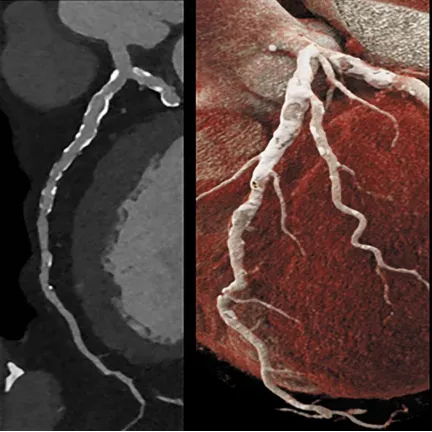
When it comes to evaluating and diagnosing heart health, not all scans are equal. If you or a loved one has ever experienced being on the other side, you might have encountered a maze of medical acronyms: CAC, CCTA (or CTCA) and CAG.
Even though they might sound the same, and though they check out the same coronary arteries, they serve different purposes using different methods. Let’s dive into what each scan is and why modern preventive cardiologists rely on CCTA to catch heart disease before they strike.
CAC scan – Coronary Artery Calcium scan
- A fast, low radiation, non-contrast CT scan. It detects calcified or hardened plaque on the walls of your coronary arteries.
- The result is a numerical score from 0 to 1000+ called the Agatston score.
- The main catch is that the scan is only visible to calcified plaque and completely blind to “soft” and non-calcified plaque – the exact type of plaque prone to sudden rupture. As a result, a CAC score of zero does not completely exclude coronary artery disease, since non-calcified plaque can’t be measured using this test.
- CAC scores also don’t directly determine the percentage of artery blockage. Results should be interpreted with age, sex, symptoms and other risk factors.
CCTA – Coronary Computed Tomography Angiography
- An advanced non-invasive 3D CT scan performed with an intravenous contrast dye that visualizes the arterial lumen – the vessel wall.
- It detects calcified plaque, soft vulnerable plaque, percentage of arterial blockage (stenosis) and provides the full view unlike CAC.
- The procedure can help identify certain types of plaques that may not be detected by calcium scoring.
- Unlike conventional CAG, which primarily visualizes the artery lumen, CCTA visualizes plaque outside the lumen that may not be apparent from CAG alone.
CAG – Conventional Coronary Angiography
- An invasive procedure where a catheter is inserted to inject dye into the heart and record real-time blood flow.
- It is mainly used in acute or high-risk cardiac situations to assess severe blockages and immediate interventions.
Why is CCTA preferred in preventive cardiology?
- Major guidelines (ACC/ESC) suggest CCTA as the primary non-invasive scan over CAC and CAG [1][2]. Unlike a zero-calcium score, CCTA detects non-calcified “soft” plaque that allows clinicians to start preventive therapy before blockages form [3]. It also acts as an accurate non-invasive procedure, measuring total plaque burden and mapping vessel health while sparing patients with unnecessary invasive catheterization.
- 2024 ESC Guidelines for the Management of Chronic Coronary Syndromes support CCTA as a first-line diagnostic test and can give more accurate information for appropriately selected patients with suspected coronary artery disease [4].
When it comes to cardiac care, early detection is the key. By identifying vulnerable plaque and hidden inflammation early, you can take targeted action long before a blockage ever forms.
HeartIQ Score Application, developed with inputs from leading cardiologists in Kerala, combines advanced technologies, brings together relevant health history of person, lifestyle factors and blood biomarker testing, to perform cardiovascular risk assessment. By connecting risk assessment with online doctor consultations and personalized guidance, HeartIQ Score helps users better understand their cardiovascular risk and make informed decisions about preventive care in consultation with a doctor.
Start your personalized HeartIQ Score assessment today at www.heartiqscore.com.
References
- Vrints C., et al. (2024). 2024 ESC Guidelines for the management of chronic coronary syndromes. European Heart Journal, 45(36), 3415–3537. doi:10.1093/eurheartj/ehae177
- Gulati M., et al. (2021). 2021 AHA/ACC/ASE/CHEST/SAEM/SCCT/SCMR Guideline for the Evaluation and Diagnosis of Chest Pain. Journal of the American College of Cardiology, 78(22), e187–e285. doi:10.1016/j.jacc.2021.07.053
- Smettei O., et al. (2025). Coronary artery calcium score of zero does not rule out obstructive CAD in young adults. American Heart Journal Plus: Cardiology Research and Practice, 62, 100707. doi:10.1016/j.ahjo.2025.100707
- European Society of Cardiology. (2024). 2024 ESC Guidelines for the Management of Chronic Coronary Syndromes. European Heart Journal. academic.oup.com
Know your heart risk before it shows
HeartIQ Score brings together a 3-minute health assessment, home blood tests and a doctor consultation to give you a clear, personalised risk picture.